Camera Tracking in Virtual Production
An introduction to camera tracking for virtual production: how the three main systems work, where they each shine, and the common issues that cause drift and wall jumps regardless of which system you're on.
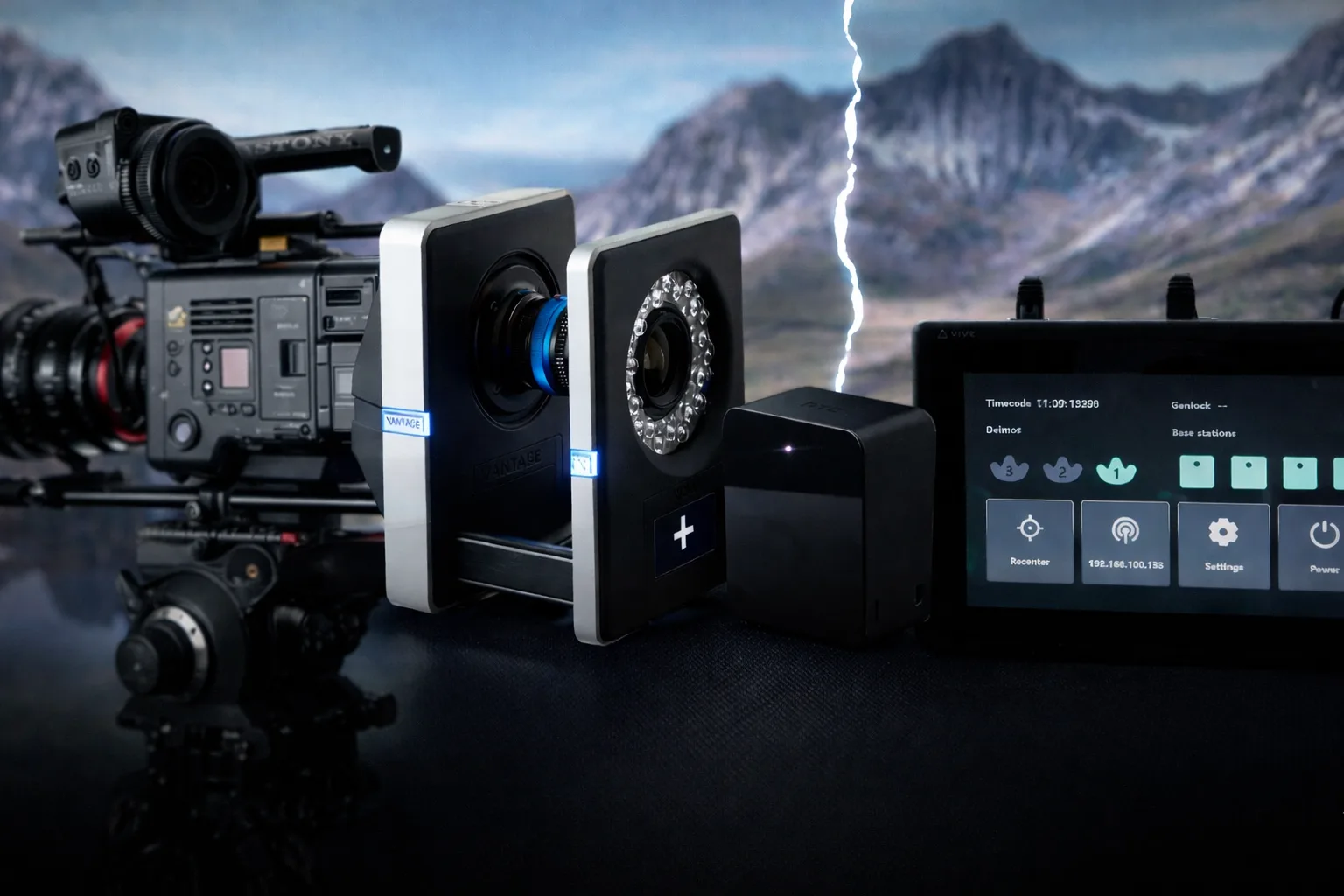
Three different approaches to the same challenge: knowing exactly where the camera is, every frame.
Key takeaways
- The tracking system tells the render engine where the camera is — any error or latency in that data breaks the illusion.
- Vicon, Mo-Sys, and Vive Mars all solve the same problem differently — the right choice depends on stage size, setup time, and show requirements.
- Most tracking problems come down to calibration, occlusion, or sync — not the system itself.
What Camera Tracking Does in VP
In virtual production, the LED wall displays a real-time render of a virtual environment. For the illusion to hold — for the background to move correctly as the camera pans or dollies — the render engine needs to know exactly where the camera is in space and what it's pointing at, updated every frame. That's the job of the tracking system. It feeds live position and rotation data to the render engine, which adjusts the virtual camera perspective accordingly. If that data is wrong, late, or inconsistent, the virtual world appears to slip, drift, or jump against the real set.
Vicon
Vicon uses a constellation of IR cameras mounted around the stage, all pointing inward at the film camera. Retroreflective markers attached to the camera body are picked up by those IR cameras simultaneously, and the system triangulates precise position and rotation from the combined data. It's a well-established system with a strong track record in both motion capture and VP.
- Strengths: high accuracy over large stage areas, robust and mature pipeline, handles complex camera rigs and cranes well.
- Watch for: marker occlusion — if a Vicon camera loses sight of enough markers, tracking degrades or drops.
- Reflective surfaces on set (chrome props, mirrors, wet floors) can contaminate the IR environment.
- Recalibrate after any significant repositioning of stage cameras or set pieces.
Mo-Sys StarTracker
Mo-Sys StarTracker works the other way around: a small IR camera is mounted on top of the film camera and looks upward at a ceiling covered in a random pattern of retroreflective dots. The system recognises clusters of those dots to calculate position and orientation in real time. Lens encoders feed focal length and focus data into the pipeline for accurate perspective matching.
- Strengths: no stage cameras required — faster setup, travels well, works on any film camera.
- Low latency and accurate for studio-scale stages; lens data integration is mature and reliable.
- Watch for: the ceiling dot pattern must be in place before the shoot — disruptions from rigging or set changes affect tracking quality.
- Verify lens encoder data matches the exact body, mount, and lens combination in use.
Vive Mars
Vive Mars is built on SteamVR lighthouse tracking — the same technology developed for the HTC Vive VR headset. Lighthouse base stations mounted around the stage emit rapidly rotating laser sweeps. Sensors attached to the camera detect those sweeps and calculate position and orientation from the timing of the hits. The system is compact, fast to set up, and low latency.
- Strengths: quick deployment, minimal stage prep, small hardware footprint.
- Well suited to smaller to mid-size stages and fast-turnaround shoots.
- Watch for: sensors on the camera need clear line of sight to at least two base stations at all times.
- Reflective surfaces can scatter the laser sweeps and introduce noise.
- Coverage area is limited compared to Vicon — base station placement needs careful planning on larger stages.
Common Issues Across All Systems
Regardless of which tracking system is in use, most problems fall into the same categories.
- Genlock and sync: the tracking system, render node, and LED processor all need to share the same sync signal and be in phase. When they're running on different clocks, timing inconsistencies show up as wall jumps or parallax errors that can look like tracking failures.
- Calibration: all three systems need to be calibrated to the stage coordinate system. A mismatch between the tracking origin and the virtual camera origin in the render engine means the wall won't align correctly even if the tracking data itself is accurate. Recalibrate after significant set changes.
- Latency: tracking data passes through several hops — tracking system -> network -> render engine -> LED processor. High latency shows as parallax; inconsistent latency causes frame-to-frame jumps. Know your system's latency profile and apply compensation offsets where available.
- Occlusion and environment: keep the stage IR-clean for Vicon, protect Mo-Sys dot patterns from disruption, and maintain clear lighthouse sightlines for Vive Mars.
More lab notes
OCIO config, calibration traps, and how to get the wall and camera pipeline speaking the same language.
Using an Unreal previs as a motion track and FLUX.2 [klein] keyframes to drive near-photorealistic output with exact camera path.